Rendering Pipeline
The entire score — notes, measure bars, dependency lines, rings, text — is drawn in one WebGL2 canvas. There is no DOM element per note. Each visual class is uploaded into per-instance typed arrays and drawn with a single drawArraysInstanced call.
Architecture
evaluation cache + module
        │
        ▼
RendererAdapter.sync()          ← CPU: rebuild all instance arrays, upload
        │  needsRedraw = true
        ▼
rAF → _render()                 ← early-returns when nothing changed
        │
        ├─ note bodies          1 instanced draw for the whole score
        ├─ selection / dependency rings
        ├─ octave guides, measure bars, dependency link-lines
└─ per-note overlays ← viewport-culled: tabs, arrows, fractions, textCoordinate systems
Musical values map to world space (renderer-config.js:12-19):
// Time → X
worldX = seconds * 200 * xScaleFactor          // scales.secondsToWorldX = 200

// Frequency → Y, logarithmic (so an octave is always the same height)
worldY = log2(baseFreq / freq) * 100 * yScaleFactor // scales.freqToWorldY = 100A note's vertical centre sits on that line, not its top edge. The top-left is derived as centerAnchorWU - heightWU / 2 (defaults 10 and 22). This is why changing note height makes notes thinner or thicker about their own frequency instead of drifting off it.
The camera supplies a 2-D affine basis (a, b, c, d, e, f) mapping world → screen CSS pixels. RendererAdapter.updateViewportBasis(raw) installs it; camera.screenToWorld() maps page CSS pixels back to world. (The camera's worldToScreen() is not its exact inverse — see Camera Controller.)
RendererAdapter
The real surface (src/renderer/webgl2/renderer.js):
class RendererAdapter {
  constructor(config = null)          // normalized against defaultRendererConfig
  init(containerEl)                   // creates the canvas + GL context, starts the rAF loop
  destroy()

  sync({ evaluatedNotes, module, xScaleFactor, yScaleFactor,
         selectedNoteId = null, tempOverrides = null })

  updateViewportBasis(raw)            // {a,b,c,d,e,f} from the camera
  setConfig(partial)                  // deep-merged into the config
  setThemeColors(colors)              // accent, noteBorder, measureBar, rings, dep colours
  setPlayhead(timeSec)
  setScaleFactors(x, y)
  setDrawNoteArrows(enabled)

  setMultiSelection(ids)  getMultiSelection()
  setMarqueeRect(rect)    pickRect(x0, y0, x1, y1)

  pickAt(clientX, clientY, expandCssPx = 2)
  pickAllAt(clientX, clientY, expandCssPx = 2)
  pickStackAt(clientX, clientY, expandCssPx = 2)
  hitTestSubRegion(clientX, clientY)

  setTempOverridesPreviewMap(map)     setDragOffsetPreview({ dxWorld, dwWorld, noteIds, anchorId })
  setMeasurePreviewMap(map)           setModuleEndPreviewSec(sec)
}There is no render(), no resize(), no dispose() — the frame loop is internal and started by init().
Shader programs
22 programs, all GLSL ES 3.00. If you write a shader here, it must start #version 300 es and use in / out / layout(location=…). There is not a single gl_FragColor in the file — a WebGL 1 snippet will fail to compile.
| Program | Draws |
|---|---|
rectProgram | note bodies (the one that scales with N) |
rectBorderProgram, borderOnlyProgram | note borders |
selectionRingProgram, selectionFillProgram | selection and dependency-highlight rings |
tabMaskProgram | the pull-tab region |
silenceDashRingProgram, silenceVLineProgram | silences |
measureDashProgram | measure bars |
measureTriProgram, measureTriOutlineProgram | measure triangles |
baseCircleProgram | the BaseNote circle |
octaveLineProgram, octaveLineInstProgram | octave guide lines |
playheadProgram | the playhead |
linkLineProgram | dependency link-lines |
marqueeProgram | the multi-select marquee |
textProgram, atlasTextProgram | text (canvas textures, and the glyph atlas) |
solidCssProgram, textCircMaskProgram, solidCssCircMaskProgram | overlay fills and circular masks |
Instance buffers
Per-instance attributes on the note-body program:
layout(location=0) in vec2  a_unit;          // the unit quad
layout(location=1) in vec4  a_posSize;       // (x, y, w, h) in world units
layout(location=2) in vec4  a_color;         // RGBA
layout(location=3) in vec2  a_noteSize;      // CSS px (deprecated, kept for compatibility)
layout(location=5) in float a_flags;         // 1.0 = silence
layout(location=6) in float a_dragFlag;      // 1.0 = apply u_dragOffset
layout(location=7) in float a_corruptionType;// 0 = clean, 1 = transitive, 2 = directNote that a_corruptionType is a float with three states, not a bitmask. The CORRUPT bitmask from binary-note.js never reaches the GPU; it is collapsed CPU-side inside sync() into this one value.
| Value | Meaning | Visual |
|---|---|---|
0.0 | clean | none |
1.0 | transitively corrupted (depends on something irrational) | single 45° diagonal hatch |
2.0 | directly corrupted (irrational, no corrupt dependency) | crosshatch |
sync() — the per-edit rebuild
sync() (renderer.js:589) rebuilds every instance array, rebuilds _noteIdToIndex, computes the corruption types, and uploads.
The corruption scan inside sync() used to be the dominant cost of a commit — a transitive BFS per note, O(N²) on deep chains. It is now one multi-source BFS over the dependents graph, seeded by the corrupt set: O(N+E), and a complete no-op when nothing is corrupt, which is the common case (renderer.js:823-898). Performance tells the full before/after story.
sync() has no per-note dirty tracking
It reallocates the CPU-side Float32Arrays for all N notes and re-uploads them wholesale with gl.bufferData(..., gl.DYNAMIC_DRAW) — 151 bufferData call sites against 4 bufferSubData. There is no double-buffering and no partial upload. This is why sync() is 63 ms p50 at 100k notes, and it is the biggest remaining performance item.
The frame
_render() starts with:
if (!this.needsRedraw) return;
this.needsRedraw = false;The rAF loop always ticks (renderer.js:501-505), and so does player.js's own loop. What is gated is the body of _render(). On an idle canvas, that gate holds and the frame costs zero draw calls — verified at 5k, 20k and 100k notes (0 of 100 frames redrawn).
Two guards make the gate real, and both are load-bearing:
setPlayhead()(renderer.js:1262) returns early when the time did not change.player.jscalls it every frame whether playing or not; dirtying unconditionally keptneedsRedrawpermanently true.updateViewportBasis()(renderer.js:551-555) returns early on an unchanged basis.player.js's rAF pushed a camera update every frame (to release the tracking X-lock), which bumped_viewEpoch60×/s on a perfectly still canvas and invalidated every view-keyed cache.
Epochs
Caches are keyed on epochs. Get these wrong and you will ship a stale frame.
| Epoch | Bumped by | Guards |
|---|---|---|
_viewEpoch | a real camera basis change (pan/zoom) | zoom-dependent screen-space buffers, measure bars, glyph runs |
_posEpoch | every sync() | glyph runs (text holds absolute CSS positions, so it goes stale when notes move), tab/arrow regions |
_sceneEpoch | end of sync() | overlay passes; part of the link-tree cache key |
_dragEpoch | every pointermove of a drag | glyph runs, dependency-line endpoints |
A drag deliberately does not bump _posEpoch — rebuilding link-line endpoints for thousands of dependents on every pointermove is too expensive, and the moving notes are shifted on the GPU via u_dragOffset rather than in posSize. But the drag anchor's posSize is rewritten on the CPU each move, so anything derived from absolute positions genuinely does go stale. _dragEpoch is that signal.
Viewport culling
The per-note overlay loop — pull tab, interval arrows, fraction divider, silence band, and all of a note's text runs — is culled against the viewport (renderer.js:6847-6878). Every overlay is scissored to that note's own rect, so a note entirely off-canvas cannot produce a single pixel; the cull is exact, not an approximation, which is why the picture stays pixel-identical.
cullPadX = 2 + (dragActive ? |m[0]·dragOffsetX| + |m[0]·dragOffsetW| : 0)The horizontal bound is widened during a drag because moving notes are offset on the GPU, not in posSize; without the slack, a note dragged in from off-screen would arrive with no overlays. Drags only shift x and width, so the vertical bound needs no slack.
Note bodies are not culled — they are one instanced draw regardless of how many are on screen.
Batched rings
_drawRingIdxList() (renderer.js:2548) is the one remaining per-instance loop that could approach O(N): it fires when a hub note with ~1000 dependents is selected.
- No drag active:
u_dragOffsetis(0,0)for every ring, so the whole bucket shares identical uniforms. The indices are gathered into one reused buffer and drawn in one instanced call — 999 draws collapse to 6. Pixel-identical: the ring shader reads onlya_posSizeper instance. - Drag active: per-instance drag offsets differ (moving vs anchor vs static), so the exact per-instance loop is kept for correctness.
Dependency highlights
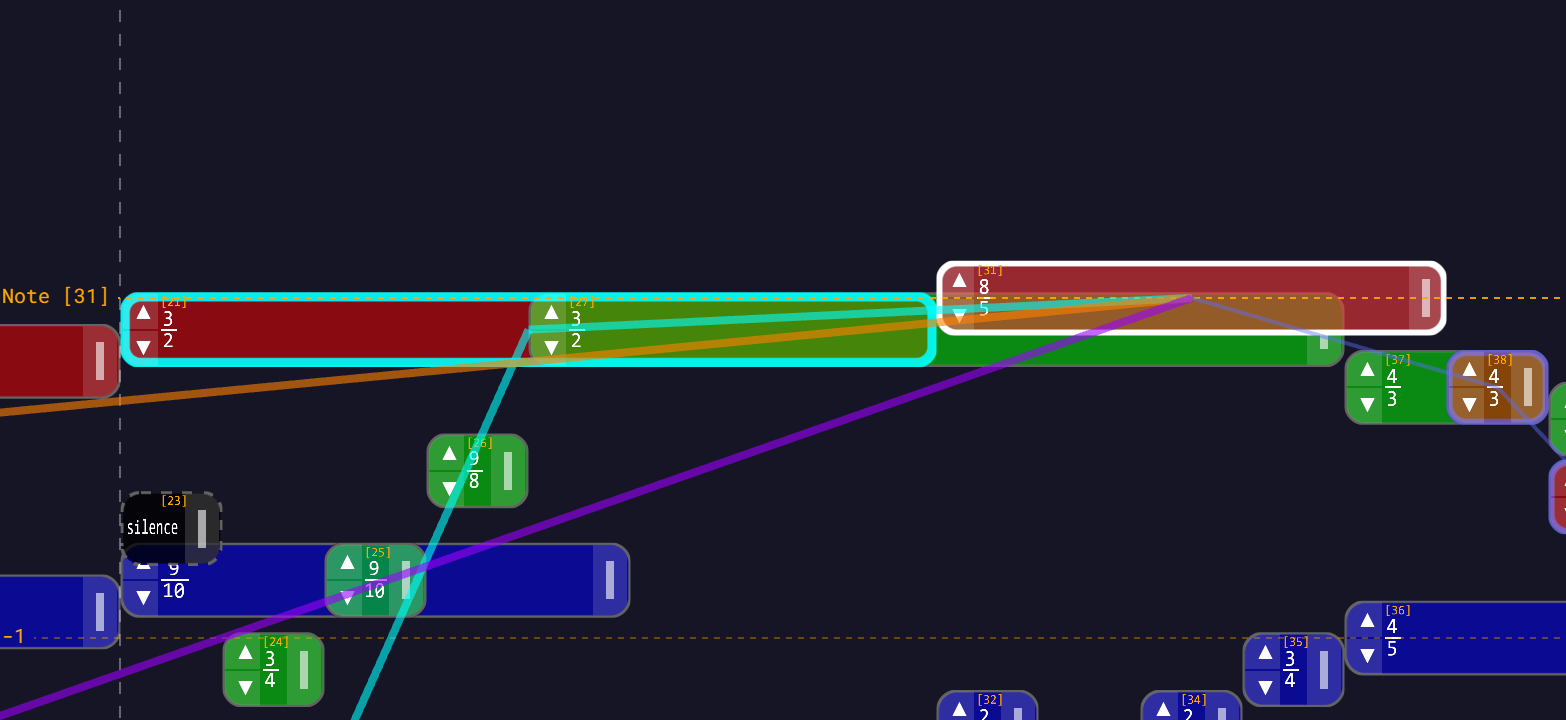
Selecting a note lights up its relatives, colour-coded by which property of the selected note would move them (renderer.js:2760-2818):
| Property | Colour | RGBA (dependency / dependent) |
|---|---|---|
| frequency | orange | [1.0, 0.5, 0.0, 0.9] / […, 0.4] |
| startTime | teal | [0.0, 1.0, 1.0, 0.9] / […, 0.4] |
| duration | purple | [0.615, 0.0, 1.0, 0.9] / […, 0.4] |
Ring thickness carries the direction: the dependency ring (what the selected note depends on) is ringThicknessPxAtZoom1 × 1.5 = 3 px; the dependent ring is × 1.0 = 2 px. Draw order is startTime → frequency → duration, so overlapping relationships all stay visible.
During a drag the property being edited stays at full brightness and the other two dim to alpha 0.15 / 0.08 — a move dims frequency and duration, a resize dims frequency and startTime.
The dependency colours are not themeable today
Every theme preset defines depFrequency / depStartTime / depDuration, themeManager passes them to renderer.setThemeColors(), and the renderer stores them on this._themeColors (renderer.js:363-365) — but nothing reads them back. Every draw path uses the hard-coded literals above (renderer.js:2774-2792, 5396-5404). Switching theme does not change a dependency ring or link-line colour. Do not document these tokens as working.
Camera
CameraController (src/renderer/webgl2/camera-controller.js) owns pan, zoom and pinch. It installs its own pointer and wheel listeners on the workspace container and hands the renderer the affine basis above; pan and zoom are not public methods — the whole surface is six methods (getBasis, screenToWorld, worldToScreen, setInputEnabled, setSingleFingerPanEnabled, destroy).
Zoom is smooth and exponential (factor exp(-deltaY * 0.0015)), always around the pointer or the pinch centre, clamped to scale 0.1–10.0. Ctrl/⌘+wheel drives the same camera zoom — browser page-zoom is suppressed app-wide — which is also what makes trackpad pinch work for free. On touch, a second finger always wins over any other gesture, and lifting one finger mid-pinch hands over to pan with no jump. lockX is playhead-tracking mode: horizontal panning is suppressed and zoom re-centres on the container's mid-X, so the view does not drift sideways while following the playhead. On container resize, the camera keeps the world point that was at the viewport centre at the new centre.
The field defaults, the gesture table, and the input-gating that lets note drags coexist with camera gestures on touch are in Camera Controller.
Picking is 100% CPU
GPU picking is not shipped
src/renderer/webgl2/picking.js is a self-described scaffold: "No draw integration yet." It is imported by nothing — never constructed, never initialized, not bundled — so the FBO it would allocate never exists. Workspace.pickAt() goes straight to renderer.pickAllAt(). Do not document or build on it.
The live path:
RendererAdapter.pickAllAt()(renderer.js:9109) — measure triangles (top) → base circle → the note stack. Returns hits top-most first.RendererAdapter.pickAt()(renderer.js:3363) — a reverse linear scan over_instanceNoteIds(last-drawn is top-most), a fast world-space AABB reject, then a precise rounded-rect test so the corners of a note are not selectable.hitTestSubRegion()(renderer.js:3426) — which sub-region was hit (pull tab, arrow column). Only runs once a note body is hit, and respects the rounded interior.
There is no spatial index, and measurement says none is warranted: pickAt is 0.017 ms at 5,000 notes and 0.314 ms at 100,000.
Configuration
Every geometry constant lives in defaultRendererConfig (renderer-config.js) and is deep-merged by setConfig(partial). The keys that define the coordinate mapping:
| Key | Default | Unit |
|---|---|---|
scales.secondsToWorldX | 200 | world units / second |
scales.freqToWorldY | 100 | world units / log2 ratio |
note.heightWU | 22 | world units |
note.centerAnchorWU | 10 | world units |
The full key-by-key table — borders, overlays, selection rings, measure dashes, the text and glyph-atlas settings — is in WebGL2 Renderer.
appearance.note.heightWU, borderPxAtZoom1 and roundedCornerPxAtZoom1 are exposed in Settings → Appearance and reach the renderer through themeManager → renderer.setConfig(). See Theming.
The glyph atlas can be forced on or off with ?atlas=1 / ?atlas=0 or the rmt:atlas localStorage key. It defaults on.
Rules for changing the renderer
The renderer used to rebuild everything every frame, which hid at least six real bugs — an arrow-region buffer clobbered by the hover overlay, an upload gated on an epoch pair that could not change during a drag, a text cache not keyed on note position. They only surfaced once redraws were gated. Assume any new cache will unmask another one.
So: measure and pixel-diff every renderer change. Never eyeball it. At minimum, run node scripts/perf/converge.mjs (does one redraw produce the final image?) and node scripts/perf/visual-regress.mjs --capture / --compare against a running dev server, always passing --url http://localhost:3000 — several harness scripts default to the wrong port. Expect a small nonzero diff: MSAA sample resolution is not bit-deterministic across runs, which is why visual-regress.mjs defaults to a 300-pixel tolerance.
The full harness — per-pass profiling, drag and pick benches, who-dirties.mjs — is documented in Performance, and the verification workflow in WebGL2 Renderer.
See also
- WebGL2 Renderer — the full
RendererAdapterreference - Camera Controller
- Picking
- Performance — the benchmark harness and the measured numbers
- Theming — how colours and geometry reach the canvas