Dependency Graph
When a note's expression references another note, that is a dependency:
# note 5's frequency
[1].f * (3/2) → note 5 depends on note 1Legacy JavaScript syntax
module.getNoteById(1).getVariable('frequency').mul(new Fraction(3, 2))src/dependency-graph.js indexes those references so that both questions are O(1):
- What does note 5 depend on? → the forward index
- What depends on note 1? → the inverse index
The inverse index is the whole reason the class exists. Without it, "what depends on note 1?" means scanning every note in the module on every drag frame:
// O(N) — what the graph replaces
getDependents(targetId) {
  return allNotes.filter(n => n.references(targetId));
}

// O(1) — what the graph does
getDependents(noteId) {
  return this.dependents.get(noteId) || new Set();
}The indexes
DependencyGraph's constructor (:12-69) builds 21 index maps and sets, plus a corruption map and an epoch counter — 22 Map/Set fields in all. They fall into four groups.
1. All-property (any expression → any expression)
| Field | Shape |
|---|---|
dependencies | Map<id, Set<id>> — forward |
dependents | Map<id, Set<id>> — inverse |
baseNoteDependents | Set<id> — notes whose expressions reference base |
2. Per-property forward / inverse / base
The same triple exists for startTime, frequency and duration:
| Property | Forward | Inverse | Base refs |
|---|---|---|---|
| startTime | startTimeDependencies | startTimeDependents | startTimeBaseNoteDependents |
| frequency | frequencyDependencies | frequencyDependents | frequencyBaseNoteDependents |
| duration | durationDependencies | durationDependents | durationBaseNoteDependents |
3. Property-pair inverse maps (9 of them)
These answer "whose X depends on this note's Y?" — the discrimination that makes a move drag differ from a resize drag, and that colours the dependency lines.
| …on startTime | …on duration | …on frequency | |
|---|---|---|---|
| startTime depends… | startTimeOnStartTimeDependents | startTimeOnDurationDependents | startTimeOnFrequencyDependents |
| frequency depends… | frequencyOnStartTimeDependents | frequencyOnDurationDependents | frequencyOnFrequencyDependents |
| duration depends… | durationOnStartTimeDependents | durationOnDurationDependents | durationOnFrequencyDependents |
Each is Map<dependencyId, Set<dependentId>>.
Only three properties get property-level indexes
startTime, frequency and duration. tempo and beatsPerMeasure do not. measureLength (VAR 5) is deliberately bucketed with duration — a measure length is derived from a duration, so a reference to [N].ml registers in the …OnDuration… maps (:129, :165, with the reasoning at :124-129).
4. Corruption
| Field | Shape | Purpose |
|---|---|---|
corruptionFlags | Map<id, u8> | which properties of a note hold an irrational value |
_corruptionEpoch | number | lets the renderer skip a buffer upload when nothing changed |
The BaseNote is not an edge
base.f sets BinaryExpression.referencesBase and lands the note in baseNoteDependents. It never appears in dependencies or dependents as an edge to note 0 — that would make the BaseNote depend on itself, and the BaseNote is note 0 (comments at src/expression-compiler.js:725-728).
Consumers simulate the edge instead. IncrementalEvaluator.topoSort() gives BaseNote dependents an implicit in-degree from note 0 when note 0 is dirty, and releases them when it processes note 0 (binary-evaluator.js:1459-1518). Module.getDependentNotes(0) unions getAllDependents(0) with getBaseNoteDependents() (module.js:385-398).
Any diagram showing note 0 as a graph edge target is wrong.
Registration
The graph does not build itself. It has no buildFromModule(). The module drives registration, one note at a time, from Module._registerNoteDependencies(note) (src/module.js:172-195) — which takes a Note object, not an id:
_registerNoteDependencies(note) {
  const regKey = `${this._depsRegGeneration}:${note.id}:${note._depsEpoch || 0}`;
  if (note._depsRegKey === regKey) return;          // ← skipped when nothing changed

  this._dependencyGraph._updateDependencies(note.id, note.getAllDependencies(), note.referencesBaseNote());
  this._dependencyGraph.registerStartTimeDependencies(note.id, note.getExpression('startTime'));
  this._dependencyGraph.registerFrequencyDependencies(note.id, note.getExpression('frequency'));
  this._dependencyGraph.registerDurationDependencies(note.id, note.getExpression('duration'));

  note._depsRegKey = regKey;
}Re-registration is skipped when dependencies cannot have changed
Dependencies derive purely from a note's compiled expressions. If the note's id, its expression epoch (Note._depsEpoch, declared at src/note.js:42 and bumped on every expression mutation — :185, :198, :213) and the graph generation are all unchanged, the note is already registered identically.
This matters because markNoteDirty() calls this for every marked note — on an interval-arrow change that is every dependent in the closure. The skip avoids rewriting up to 21 maps per untouched note.
The bytecode scan that finds the references lives on the expression, not the graph: BinaryExpression.getPropertyDependencies() (src/binary-note.js:221) walks the bytecode for LOAD_REF instructions and returns Map<noteId, Set<varIndex>>. getDependencySet() returns the flat id set.
_updateDependencies() (:442-496) diffs old against new, patches the inverse index, and bumps _corruptionEpoch if the dependency set actually changed — because changing a note's dependencies can change whether other notes render as transitively corrupted, even if no corruption flag moved.
Query surface
These are the real method names.
Basic
| Method | Returns | Line |
|---|---|---|
getDependencies(id) | Set — direct, O(1) | :673 |
getDependents(id) | Set — direct, O(1) | :684 |
getAllDependents(id) | Set — transitive closure (BFS) | :695 |
getAllDependencies(id) | Set — transitive, upward | :1245 |
getBaseNoteDependents() | Set | :1274 |
Module.getDirectDependencies(id) and Module.getDependentNotes(id) wrap these and return Arrays, not Sets (module.js:377, :385).
Property-scoped traversals
These back the property-coloured dependency lines and the drag preview. Each is a BFS that propagates across properties — changing a frequency can move a note's startTime, which moves its dependents' startTimes in turn.
| Method | Answers | Line |
|---|---|---|
getAllAffectedByFrequencyChange(id) | everything that moves if this note's frequency changes | :944 |
getAllAffectedByStartTimeChange(id) | …its startTime changes | :1159 |
getAllAffectedByDurationChange(id) | …its duration changes | :1073 |
Module.getDependentsByProperty(id) (module.js:412) calls all three and returns {frequency: [], startTime: [], duration: []} — which is exactly what the renderer colours:
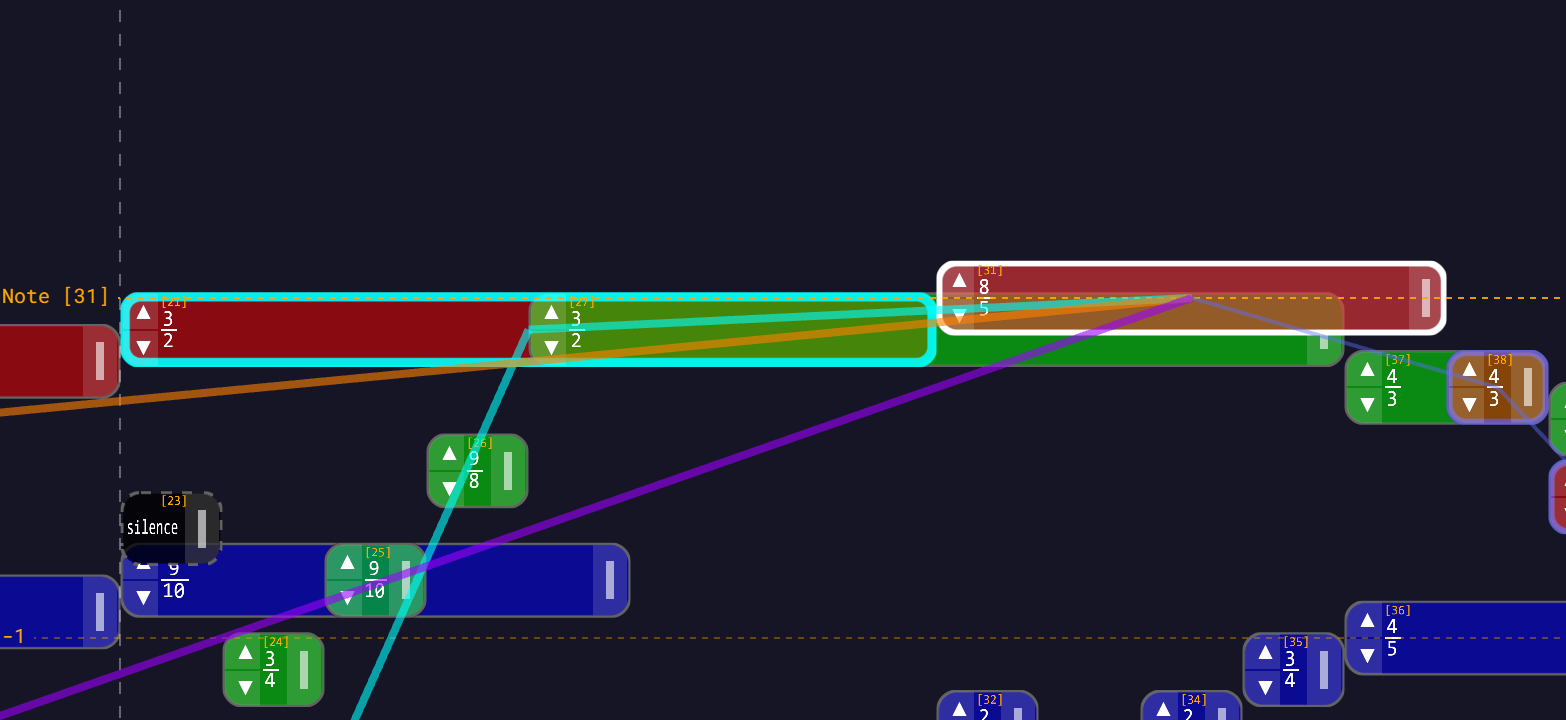
Thicker lines are what the selected note depends on; thinner lines are what depends on it.
The drag path uses the narrower startTime traversals directly: getAllStartTimeOnStartTimeDependents(id) (:800), getAllStartTimeOnDurationDependents(id) (:831), getAllStartTimeOnFrequencyDependents(id) (:891). A note whose frequency references the dragged note does not move when you drag it, and these are how that is known.
Trees and chains
| Method | Returns | Line |
|---|---|---|
getChildrenTreeByProperty(id, property) | {edges: [{parentId, childId, depth}], maxDepth} — property is 'frequency' | 'startTime' | 'duration' | :1410 |
getChildrenTreeByAllProperties(id) | {edgesByProperty: {frequency: [], startTime: [], duration: []}, maxDepth} — all three in one traversal. Not the same shape as above: the edges are bucketed by originating property, not flat | :1521 |
getMeasureChain(measureId, isMeasure, getStartTime, isChainLink?) | [{id, startSec}] — the linear measure chain, earliest to latest, O(chain length) | :1830 |
getMeasureChain() is live: src/player.js:6258 and src/renderer/webgl2/workspace.js:2808 both use it.
Structural
| Method | Returns | Line |
|---|---|---|
hasDependencyPath(source, target) | boolean — BFS up the forward index | :1285 |
detectCycles() | Array<Array<id>> — recursive DFS | :1314 |
getEvaluationOrder(noteIds) | Array<id> — Kahn topological sort | :1357 |
removeNote(id) | — unlinks the note from every index | :503 |
clear() | — empties every index | :1624 |
stats() | {noteCount, totalDependencies, avgDependencies, maxDependencies, maxDependents, baseNoteDependents, corruptedNotes} | :1794 |
debug() | console dump | :1904 |
getEvaluationOrder, detectCycles and hasDependencyPath have no callers in the app
They are API surface, mirrored by the WASM graph adapter. Evaluation does not use them. The sort that actually orders evaluation is IncrementalEvaluator.topoSort() in src/binary-evaluator.js:1454 — a separate Kahn implementation with a BaseNote release path. The cycle guard a user actually hits is detectCircularDependency() in src/modals/validation.js:190, a BFS over Module.getDirectDependencies().
Corruption tracking
The graph owns this and nothing else does. A property is corrupted when a ^ produced an irrational — 2^(1/12). See SymbolicPower.
| Method | Effect | Line |
|---|---|---|
setCorruptionFlags(id, flags) | stores the u8 bitmask. Bumps _corruptionEpoch only if the value changed; a 0 deletes the entry. | :1659 |
getCorruptionFlags(id) | u8, 0 if clean | :1676 |
getCorruptionEpoch() | number | :1684 |
isNoteCorrupted(id) | any bit set | :1694 |
isPropertyCorrupted(id, flag) | e.g. flag = 0x04 for frequency | :1705 |
getCorruptedNotes() | Set<id> — usually empty | :1724 |
isFrequencyTransitivelyCorrupted(id) | direct check, then BFS up the frequency chain | :1741 |
getAllFrequencyDependencies(id) | transitive frequency ancestors | :1770 |
clearCorruptionFlags(id) | delete | :1715 |
Flags arrive from Module._updateCorruptionFlags() after each evaluation (module.js:636-659), scoped to the dirty set.
How the renderer consumes it
RendererAdapter.sync() needs, for every note, "is anything in my dependency closure corrupt?". Because dependents is the maintained inverse of dependencies, that is answered for all notes at once by one multi-source BFS over the dependents graph, seeded by getCorruptedNotes() — O(N+E) instead of a transitive BFS per note, and a complete no-op when the corrupt set is empty, which is the common case (renderer.js:823-898). The scan produces the per-note a_corruptionType attribute the shader hatches from (0 clean, 1 transitive → single diagonal hatch, 2 direct → crosshatch); the before/after numbers are in Performance.
_corruptionEpoch is what lets the renderer know it can skip this work. It is bumped from two places — setCorruptionFlags() when a flag changes, and _updateDependencies() when a note's dependency set changes. Both can alter transitive corruption.
Space
There is no single multiplier. The graph keeps:
- 2 all-property maps + 1 base set = 3
- 3 × (forward + inverse + base set) = 9 per-property structures
- 9 property-pair inverse maps
- 1 corruption map
21 indexes, plus the corruption map. An edge is recorded in the all-property pair and in each per-property structure it belongs to and in the relevant property-pair map. The honest source is stats() (:1794) — call it on a real module rather than trusting a constant factor.
See also
- Binary Evaluator —
getAllDependents()andgetBaseNoteDependents()feed the topological sort - Expression Compiler —
getPropertyDependencies()is where the edges come from - SymbolicPower — what sets a corruption flag
- Dependencies — the user-facing view