Microtonal Composition
Write music outside 12-tone equal temperament. RMT Compose stores every pitch as an expression, not a number, so a tuning system is something you write down rather than something you configure.
Prerequisites: Octave Manipulation — you will use ratios and the ^ operator throughout.
Start with what ships
Before you hand-enter a scale, check the library. The Scale Systems section holds six ready-made tuning systems, and Intervals holds 46 just ratios with their cents and limit family attached.
| Scale Systems module | Notes | Step written as |
|---|---|---|
| 12-TET | 13 | [N-1].f * 2 ^ (1/12) |
| 19-TET | 20 | [N-1].f * 2 ^ (1/19) |
| 31-TET | 32 | [N-1].f * 2 ^ (1/31) |
| Bohlen–Pierce | 14 | [N-1].f * 3 ^ (1/13) |
| Tesla | 81 | successive odd harmonics over 9 |
| Mixed-Base | 12 | alternating 2-, 3- and 5-based steps |
Each scale is chained: note 1 sits on base.f, and every later note is the previous note's frequency times one step. Lifting one note carries every note after it. Drag the module onto a note and the whole scale re-roots onto that note.
Find things by ratio, not by scrolling
The magnifier at the left of the module bar's toolbar opens a search field (Search name, ratio, tag…). It matches the module name, its ratio, its cents, its family (3-limit, 7-limit, comma, …) and its tags — so typing 7/4, septimal or comma narrows 79 modules to the handful you want. Matches surface even inside collapsed sections. Closing the field always clears the query.
Pure intervals vs equal temperament
12-TET divides the octave into 12 equal parts, each 2^(1/12) ≈ 1.0595. That is a compromise: every interval except the octave is slightly off its pure ratio.
| Interval | Pure ratio | Pure cents | 12-TET cents | Error |
|---|---|---|---|---|
| Just major 3rd | 5/4 | 386.3 | 400 | +13.7 |
| Perfect 5th | 3/2 | 702.0 | 700 | −2.0 |
| Harmonic 7th | 7/4 | 968.8 | 1000 | +31.2 |
Pure ratios are written as fraction literals:
base.f * (5/4)          # just major third
base.f * (3/2)          # perfect fifth
base.f * (7/4) # harmonic seventhThe parentheses are part of the fraction literal. (5/4) is an exact rational; 5/4 written bare is a division that still evaluates exactly, but the literal form is what the app itself writes and what round-trips through a save.
Legacy JavaScript syntax
module.baseNote.getVariable('frequency').mul(new Fraction(5, 4))Equal temperaments
An n-TET step is 2 ^ (1/n). Take k of them with 2 ^ (k/n).
19-TET
base.f * 2^(3/19)       # major second  (3 steps)
base.f * 2^(6/19)       # major third   (6 steps)
base.f * 2^(11/19) # perfect fifth (11 steps)19-TET's major third is 378.9¢ — 7.4 cents flat of pure, where 12-TET is 13.7 cents sharp.
31-TET
base.f * 2^(10/31)      # major third   (10 steps)
base.f * 2^(18/31) # perfect fifth (18 steps)31-TET's major third lands within a cent of 5/4, which is why it is the classic meantone-adjacent temperament for just-sounding harmony.
24-TET (quarter tones)
No 24-TET module ships — write it directly:
base.f * 2^(1/24)       # quarter tone up
base.f * 2^(2/24)       # one 12-TET semitone
base.f * 2^(3/24) # three-quarter tone^ binds tighter than *
base.f * 2 ^ (1/12) parses as base.f * (2^(1/12)), which is what you want. But 2^3^2 is 2^(3^2) — the power operator is right-associative. Parenthesise when in doubt.
Interval comparison
| Interval | Pure | 12-TET | 19-TET | 31-TET |
|---|---|---|---|---|
| Major 2nd | (9/8) | 2^(2/12) | 2^(3/19) | 2^(5/31) |
| Major 3rd | (5/4) | 2^(4/12) | 2^(6/19) | 2^(10/31) |
| Perfect 4th | (4/3) | 2^(5/12) | 2^(8/19) | 2^(13/31) |
| Perfect 5th | (3/2) | 2^(7/12) | 2^(11/19) | 2^(18/31) |
| Major 6th | (5/3) | 2^(9/12) | 2^(14/19) | 2^(23/31) |
Bohlen–Pierce
A non-octave scale. The period is the tritave (3/1), divided into 13 equal steps:
base.f * 3^(1/13)       # one BP step
base.f * 3^(5/13)       # five BP steps
base.f * 3^(13/13) # the tritave — exactly 3 x baseBP is built on odd harmonics (3, 5, 7, 9) rather than the even ones an octave-based scale emphasises, which gives it a distinctly clarinet-friendly, hollow palette. The shipped Bohlen–Pierce module is 14 notes: the root plus all 13 steps to the tritave.
Just intonation
5-limit
Ratios whose prime factors are only 2, 3 and 5.
| Degree | Ratio | Cents | Ships as |
|---|---|---|---|
| Unison | 1/1 | 0 | Unison |
| Major 2nd | 9/8 | 203.9 | Major 2nd |
| Major 3rd | 5/4 | 386.3 | Just major 3rd |
| Perfect 4th | 4/3 | 498.0 | Perfect 4th |
| Perfect 5th | 3/2 | 702.0 | Perfect 5th |
| Major 6th | 5/3 | 884.4 | Just major 6th |
| Major 7th | 15/8 | 1088.3 | Just major 7th |
| Octave | 2/1 | 1200 | Octave |
base.f * (5/4)          # E
base.f * (3/2)          # G
base.f * (5/3) # A7-limit and beyond
The seventh harmonic gives the "barbershop" seventh; 11 and 13 give neutral intervals that sit between major and minor.
| Name | Ratio | Cents | Family |
|---|---|---|---|
| Septimal minor 3rd | 7/6 | 266.9 | 7-limit |
| Septimal tritone | 7/5 | 582.5 | 7-limit |
| Harmonic 7th | 7/4 | 968.8 | 7-limit |
| Undecimal neutral 3rd | 11/9 | 347.4 | higher |
| Undecimal neutral 7th | 11/6 | 1049.4 | higher |
| Tridecimal neutral 2nd | 13/12 | 138.6 | higher |
| Tridecimal neutral 6th | 13/8 | 840.5 | higher |
All seven ship as interval modules. So do the six commas — Syntonic (81/80), Septimal (64/63), Pythagorean (531441/524288), Enharmonic diesis (128/125), Diaschisma (2048/2025) and Schisma (32805/32768).
Building a microtonal composition
Drop mode: Start / End
The drop-mode buttons in the module bar's toolbar — ⇤ and ⇥, just left of Undo/Redo — decide where a dropped module lands relative to the target note. Exactly one is lit at a time.
- End (⇥) — the module's notes are pushed past the target note's end. Chains scales and melodies.
- Start (⇤) — the module's notes share the target's start time. Stacks chords.
Default is Start. Note that dropping onto the BaseNote ignores the drop mode entirely.
A 19-TET melody, by hand
Four notes, each starting where the previous one ends, each pitched off note 1:
| Note | frequency | startTime | duration |
|---|---|---|---|
| 1 | base.f | base.t | beat(base) |
| 2 | [1].f * 2^(3/19) | [1].t + [1].d | beat(base) |
| 3 | [1].f * 2^(6/19) | [2].t + [2].d | beat(base) |
| 4 | [1].f * 2^(8/19) | [3].t + [3].d | beat(base) |
Create every note from the ADD NOTE / SILENCE section of a widget. Note 1 comes from the BaseNote's widget, which has no At Start / At End toggle — it always writes base.t — and whose button reads Create. Notes 2–4 come from the previous note's widget: pick Note, pick At End, then press Create Note. Then open each variable's Raw: field and type the expression above. Edits take effect when you press Save, not while you type.
A just dominant seventh
All four notes share note 1's start and length; only the pitch differs.
| Note | frequency | startTime | duration |
|---|---|---|---|
| 1 (root) | base.f | base.t | beat(base) * 2 |
| 2 (major 3rd) | [1].f * (5/4) | [1].t | [1].d |
| 3 (fifth) | [1].f * (3/2) | [1].t | [1].d |
| 4 (harmonic 7th) | [1].f * (7/4) | [1].t | [1].d |
Because every tone hangs off note 1, moving or retuning note 1 moves the whole chord. That is the same structure the shipped Harmonic 7th chord module uses (4:5:6:7).
What ≈ and the hatching mean
Type base.f * 2^(1/12) and two things happen.
In the note widget, the Evaluated: line shows a value with a ≈ prefix, in italic amber.
In the workspace, the note rectangle is hatched:
| Hatch | Meaning |
|---|---|
| Crosshatch (two diagonals) | The note's own expression produced an irrational value |
| Single diagonal | The note is clean, but something it depends on is not |
Both cases display ≈. The hatching is what tells them apart.
≈ means approximated, not merely rounded
When a ^ produces a genuinely irrational result, the evaluator converts it straight back to a rational approximation and marks the property corrupted. The stored value really is an approximation — subsequent arithmetic works on the approximation, not on a symbolic form.
A power that resolves to a rational is not corrupted: 2^(12/12) is exactly 2, and 4^(1/2) is exactly 2. Only genuinely irrational powers hatch.
Understanding SymbolicPower works through exactly where the line falls and how much error accumulates when you chain irrational steps.
Listening well
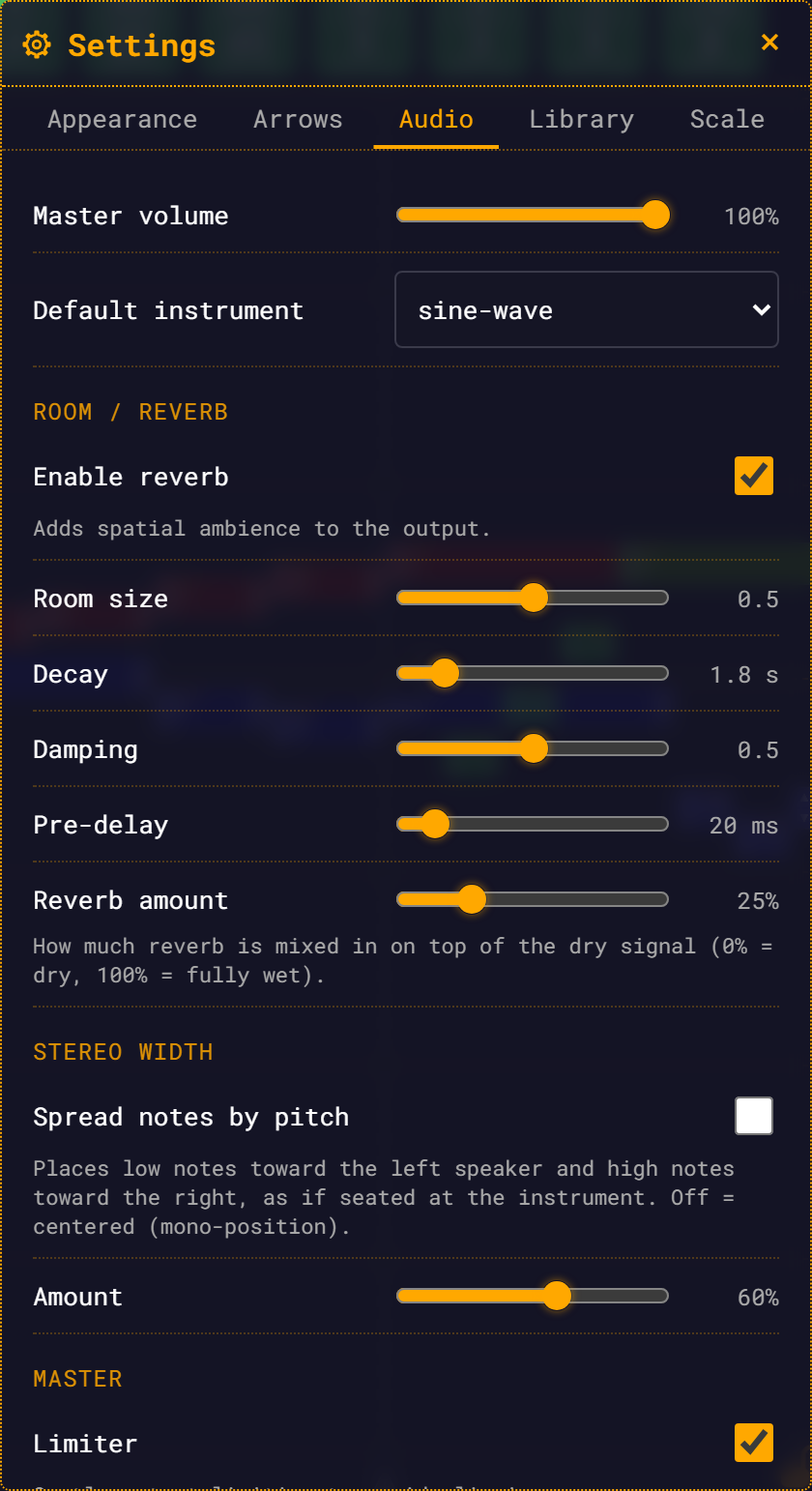
Turn reverb off
Reverb is on by default (25% wet, 1.8 s decay). It smears the beating you are trying to hear. Open the Settings panel from the top-bar gear, go to the Audio tab and switch off Enable reverb before any tuning comparison.
Use sustained notes
Beating between two nearly-in-tune pitches takes time to become audible. Give test notes at least a couple of beats. beat(base) * 4 is a reasonable starting length.
Pick a timbre that reveals it
A sine-wave shows the beat rate between two fundamentals most cleanly; organ and violin add harmonics that expose roughness higher up. Set the default in Settings → Audio → Default instrument, or set one note's instrument from its widget. The full listening rig — all nine instruments and the settings worth changing — is in Microtonal Experiments.
Loop it
Shift-click (or long-press) the Play button to loop playback. Park on a sustained dyad and let it beat at you indefinitely while you retune the upper note.
Save what you find
Select the notes of a scale you like — shift-drag a marquee across them on desktop, or long-press and drag on touch — then press Copy to Modules in the group widget. The selection lands in the library's Custom section as a module, rooted at its earliest note, with the dependency tree intact. Drag it back onto any note to transpose the whole thing.
Copy to Modules drops note colours and instruments
The copied module keeps pitches, times and durations as relationships, but per-note color and instrument are not carried across. Re-set them after you drop the copy back in.
Next
- Understanding SymbolicPower — what "exact" really covers
- Microtonal Experiments — a structured listening workflow
- Exploring Intervals — systematic study of the 46 shipped intervals
- Bohlen-Pierce and Custom TET — reference