Microtonal Experiments
Seven experiments. Each one is a listening test with a controlled setup, and each takes a few minutes. Do the setup first — without it, most of these experiments measure your reverb rather than your tuning.
Setup: make the app honest
Turn reverb off before you listen to anything
Reverb ships on (25% wet, 1.8 s decay). Every experiment below depends on hearing beating — the slow throb between two nearly-coincident partials — and reverb smears exactly that. An experiment run with reverb on is worthless.
Open the Settings panel from the top-bar gear → Audio tab → switch off Enable reverb.
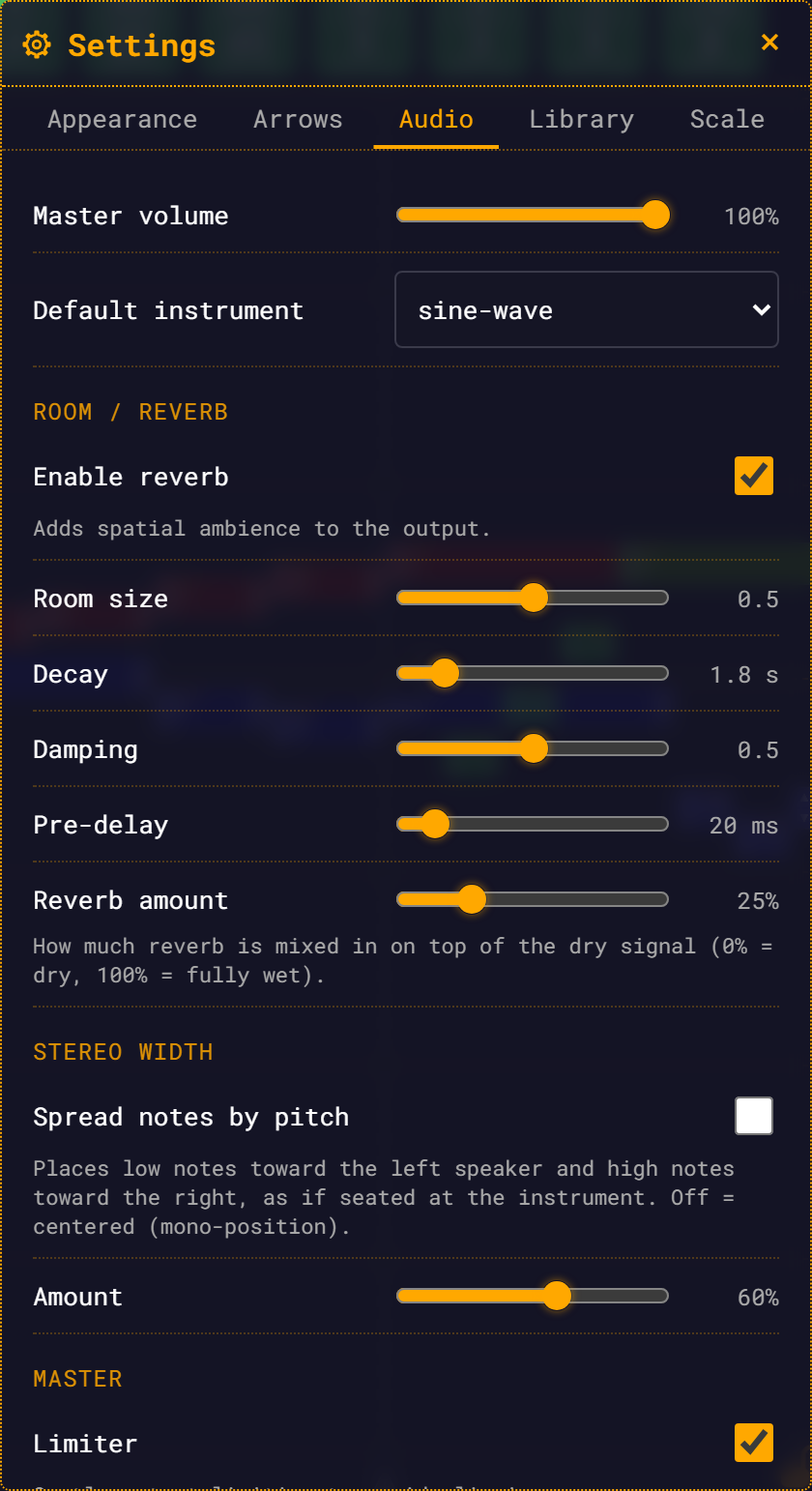
While you are there:
| Setting | Set it to | Why |
|---|---|---|
| Enable reverb | off | It masks beating |
| Spread notes by pitch | off (default) | Beating is clearest when both tones share a speaker |
| Limiter | on (default) | Stops a stack of sustained sines from clipping |
| Default instrument | sine-wave | A pure tone shows the beat rate between fundamentals most cleanly |
Use long notes. Beating takes time to become audible. beat(base) * 4 is a sensible minimum.
Loop it. Shift-click (or long-press) the Play button. The play icon's bars become dashes orbiting a figure-8 while the loop runs. Park on a sustained dyad and let it beat at you while you retune the upper note. Shift-click again to exit.
Nine instruments ship: sine-wave, square-wave, sawtooth-wave, triangle-wave, organ, vibraphone, fm-epiano, piano, violin. piano and violin are multisampled. A sine isolates the fundamentals; organ and violin add upper partials that expose roughness a sine will hide. The instrument is a per-note property — set it from the note widget — and a note without one inherits it up its frequency chain.
The basic rig
Two notes, sounding together, one of which you retune.
| Note | frequency | startTime | duration |
|---|---|---|---|
| 1 (reference) | base.f | base.t | beat(base) * 4 |
| 2 (the variable) | [1].f * 2^(1/19) | [1].t | [1].d |
Edit note 2's frequency in its Raw: field, press Save, listen. Repeat.
Experiment 1 — TET comparison
Question: which equal temperament gets closest to a pure major third?
Five notes, all starting together, all lasting the same:
| Note | frequency | Cents | |
|---|---|---|---|
| 1 | base.f | 0 | reference |
| 2 | [1].f * (5/4) | 386.31 | pure |
| 3 | [1].f * 2^(4/12) | 400 | 12-TET |
| 4 | [1].f * 2^(6/19) | 378.95 | 19-TET |
| 5 | [1].f * 2^(10/31) | 387.10 | 31-TET |
Play note 1 with each of 2–5 in turn (mute the others by dragging them out of the playhead's path, or build them as four separate pairs).
Expect:
- Pure 5/4 — dead still. No beating.
- 12-TET — 13.7¢ sharp. A clear, countable shimmer.
- 19-TET — 7.4¢ flat. Beats the other way, slower than 12-TET.
- 31-TET — 0.8¢ sharp. Very nearly as still as pure.
Notes 3, 4 and 5 will be crosshatched and show ≈ — their powers are irrational and have been approximated. Note 2 is clean. That is correct, and it is worth knowing why: Understanding SymbolicPower.
Skip the typing
12-TET, 19-TET and 31-TET all ship as complete scales in the library's Scale Systems section. Drag one onto a note and you get the whole chain, each note a step above the last.
Experiment 2 — neutral intervals
Question: what lives between major and minor?
The neutral third sits around 350¢, between minor (6/5, 315.6¢) and major (5/4, 386.3¢).
| Note | frequency | Cents |
|---|---|---|
| 1 | base.f | 0 |
| 2 | [1].f * (6/5) | 315.64 |
| 3 | [1].f * (11/9) | 347.41 |
| 4 | [1].f * (5/4) | 386.31 |
Play 1+2, then 1+3, then 1+4. The middle one refuses to declare itself happy or sad.
Neutral intervals that ship as modules:
| Name | Ratio | Cents |
|---|---|---|
| Tridecimal neutral 2nd | 13/12 | 138.57 |
| Undecimal neutral 3rd | 11/9 | 347.41 |
| Tridecimal neutral 6th | 13/8 | 840.53 |
| Undecimal neutral 7th | 11/6 | 1049.36 |
Experiment 3 — septimal intervals
Question: what does the seventh harmonic sound like?
| Note | frequency | Cents | |
|---|---|---|---|
| 1 | base.f | 0 | reference |
| 2 | [1].f * (7/6) | 266.87 | septimal minor 3rd |
| 3 | [1].f * (7/5) | 582.51 | septimal tritone |
| 4 | [1].f * (7/4) | 968.83 | harmonic 7th |
The barbershop seventh. Compare [1].f * (7/4) (968.83¢) against [1].f * 2^(10/12) (1000¢) — 31 cents apart. The 7/4 locks; the tempered one grinds. This is the interval barbershop quartets tune by ear and no keyboard can play.
Then drop the shipped Harmonic 7th chord (4:5:6:7) onto a note and hear all four tones lock at once. Note that the Dominant 7th chord module is a different thing — its seventh is 16/9, not 7/4, deliberately, so that against the 5/4 third it produces the canonical 64/45 tritone.
Experiment 4 — Bohlen–Pierce
Question: what does a scale sound like with no octave in it?
BP divides the tritave (3/1) into 13 equal steps. There is no 2/1 anywhere in it.
This one ships
Drag the Bohlen–Pierce module (Scale Systems) onto a note. It is 14 notes: the root plus all 13 steps to the tritave. Build it by hand only if you want to feel the chain.
By hand, each note is one step above the previous:
| Note | frequency |
|---|---|
| 1 | base.f |
| 2 | [1].f * 3^(1/13) |
| 3 | [2].f * 3^(1/13) |
| 4 | [3].f * 3^(1/13) |
…and so on to note 14, which lands on 3 × base.f.
BP consonances — BP emphasises odd harmonics (3, 5, 7, 9) rather than even ones:
| Steps | Expression | Cents |
|---|---|---|
| 4 | base.f * 3^(4/13) | 585.22 |
| 6 | base.f * 3^(6/13) | 877.83 |
| 9 | base.f * 3^(9/13) | 1316.74 |
Play a BP triad against a normal major triad. The BP one is recognisably harmony and recognisably not Western.
Experiment 5 — commas
Question: how small an interval can you hear?
The syntonic comma (81/80, 21.5¢) is the gap between a Pythagorean major third and a pure one.
| Note | frequency | |
|---|---|---|
| 1 | base.f | reference |
| 2 | [1].f * (81/64) | Pythagorean major 3rd — 407.82¢ |
| 3 | [1].f * (5/4) | just major 3rd — 386.31¢ |
Play 2 and 3 together, without note 1. They are 21.5 cents apart and they beat, slowly and obviously. That beat is the comma.
All six commas ship as modules:
| Name | Ratio | Cents | What it is |
|---|---|---|---|
| Schisma | 32805/32768 | 1.95 | Pythagorean comma minus syntonic comma |
| Diaschisma | 2048/2025 | 19.55 | How far four fifths + two major thirds fall short of three octaves |
| Syntonic comma | 81/80 | 21.51 | Pythagorean 3rd (81/64) vs pure 3rd (5/4) |
| Pythagorean comma | 531441/524288 | 23.46 | The gap after 12 pure fifths |
| Septimal comma | 64/63 | 27.26 | 16/9 vs 7/4 |
| Enharmonic diesis | 128/125 | 41.06 | Three pure major thirds vs an octave |
Drag two onto the same note and hear how close together the Syntonic and Pythagorean commas are — 2 cents apart, which is the Schisma.
Experiment 6 — quarter tones
Question: what is available between the semitones?
24-TET does not ship as a module. Write it:
| Note | frequency | Cents |
|---|---|---|
| 1 | base.f | 0 |
| 2 | [1].f * 2^(1/24) | 50 |
| 3 | [1].f * 2^(2/24) | 100 (a 12-TET semitone) |
| 4 | [1].f * 2^(3/24) | 150 |
Then build a melody using the steps 12-TET cannot reach — 1, 3, 5, 7 quarter-tones. The odd steps are the ones that will sound alien.
Experiment 7 — design your own scale
From ratios
Pick degrees by harmonic relationship rather than by keyboard habit:
| Degree | Ratio | Cents |
|---|---|---|
| 1 | 1/1 | 0 |
| 2 | 13/12 | 138.57 |
| 3 | 7/6 | 266.87 |
| 4 | 4/3 | 498.05 |
| 5 | 7/5 | 582.51 |
| 6 | 8/5 | 813.69 |
| 7 | 7/4 | 968.83 |
| 8 | 2/1 | 1200 |
Every one of those is an interval module. Set the drop mode to End (the ⇥ button next to Undo/Redo in the module bar's toolbar) and drag them onto each other in sequence to chain the scale.
From an unusual division
Any n works — write 2 ^ (k/n):
base.f * 2^(10/17)      # a fifth in 17-TET  (705.9c)
base.f * 2^(13/22)      # a fifth in 22-TET  (709.1c)
base.f * 2^(24/41) # a fifth in 41-TET (702.4c)From mixed bases
The shipped Mixed-Base module is the demonstration that a scale need not have a single period at all — it alternates 2-based, 3-based and 5-based steps and still returns home to base.f:
[7].f * 2 ^ (-1/12) * 3 ^ (-1/13)
[8].f * 5 ^ (1/7)Drag it in and read the frequency expressions note by note. It is the best argument in the app for why pitches are stored as expressions.
Keeping what you find
When an experiment produces something worth keeping:
- Marquee-select the notes — shift-drag across empty background (desktop), or long-press and drag (touch).
- Press Copy to Modules in the group widget.
It lands in the library's Custom section, rooted at its earliest note, with the dependency tree intact — so dropping it on a different note transposes the whole thing. This is strictly better than saving a file and re-uploading it.
Per-note color and instrument survive the copy too — pitch, timing, structure, look and timbre all come across.
The library is flat
There is one level of section — no nested folders. Use Add Category to make a section like "17-TET experiments", and rely on the search magnifier (which matches ratio, cents, family and tags) for everything else.
Habits that make the difference
Always A/B. A tuning never sounds like anything on its own; it sounds like something compared to another. Keep the reference note in every test.
Rest your ears. Ear fatigue is real and it arrives faster than you think during beat-counting.
Trust your ears over the cents. The numbers tell you what you should hear. They are frequently less interesting than what you actually hear.
Next
- Microtonal Composition — turn discoveries into music
- Building a Module Library — organise what you keep
- Exploring Intervals — the 46 shipped ratios in full