Equal Temperament
Equal temperament divides an interval into equal steps. Twelve equal divisions of the octave give you a piano. Nineteen give you better thirds. Thirteen equal divisions of the tritave give you Bohlen–Pierce.
In RMT Compose a TET step is an exponent: 2 ^ (1/12) is a semitone, 3 ^ (1/13) is a Bohlen–Pierce step. You write them in the expression; the app keeps the power term intact rather than flattening it to a decimal.
Why temper at all
Pure fifths do not close a circle. Stack twelve of them:
(3/2)^12 = 129.746…Stack seven octaves:
2^7 = 128They miss by 23.46 cents — the Pythagorean comma. You cannot have twelve pure fifths and pure octaves in the same instrument. Equal temperament spends that comma evenly: every fifth is narrowed by about 2 cents, every key ends up equally usable, and modulation stops being a trap.
Every temperament is a different answer to "what do I compromise?" 12-TET protects the fifth and sacrifices the third. 19-TET does the opposite. 31-TET protects almost everything and costs you 31 notes per octave.
The step formula
To divide interval I into N equal steps, one step is I^(1/N):
2 ^ (1/12)          # one 12-TET semitone
2 ^ (1/19)          # one 19-TET step
2 ^ (1/31)          # one 31-TET step
3 ^ (1/13) # one Bohlen-Pierce step (tritave-based)k steps is I^(k/N):
2 ^ (7/12)          # 12-TET perfect fifth
2 ^ (6/19) # 19-TET major third^ binds tighter than *, so base.f * 2 ^ (7/12) means base.f * (2^(7/12)). No extra parentheses needed.
base.f * 2 ^ (4/12)     # a 12-TET major third above the BaseNote
[1].f * 2 ^ (1/12) # one semitone above note 1Legacy JavaScript syntax
module.baseNote.getVariable('frequency').mul(new Fraction(2).pow(new Fraction(4, 12)))
module.getNoteById(1).getVariable('frequency').mul(new Fraction(2).pow(new Fraction(1, 12)))Chaining a scale
Every shipped TET module is built the same way: note 1 is base.f, and every later note is the previous note times one step.
# note 1
base.f
# note 2
[1].f * 2 ^ (1/12)
# note 3
[2].f * 2 ^ (1/12)
# … and so onOnly note 1 touches base. That makes the scale a chain: lift one note and every note after it follows. It also means an N-TET module has N + 1 notes — one full period plus the note you started on.
What stays exact, and what does not
This is the part that matters, and it is narrower than it looks.
The expression stays symbolic. 2 ^ (1/12) is stored as a power term, not as 1.0594630943592953. It survives saving, loading, dragging and the ▲/▼ arrows.
Like bases merge on save. Type 2^(1/12) * 2^(1/12) * base.f, press Save, and the simplifier stores 2^(1/6) * base.f. Twelve semitones collapse to 2, exactly.
Perfect roots resolve. 4^(1/2) * base.f saves as 2 * base.f. The note is no longer irrational, and the ≈ marker disappears.
Only positive integer bases stay symbolic. MusicValue.pow creates a symbolic power for bases like 2, 3 and 5. A non-integer base — say (1618/1000) for a golden-ratio scale — takes the float path instead and every step downstream is ordinary floating-point arithmetic.
The evaluated number is still an approximation
Keeping 2^(1/12) in the expression is not the same as evaluating it exactly. When the app computes a note's actual frequency, an irrational power is converted straight back to an approximating rational for the audio and render pipeline, and the note is flagged as corrupted. The algebra is exact; the number you hear is a very good approximation of it. Do not expect a TET note to report a closed-form value.
The ≈ marker
A note whose frequency involves an irrational power is corrupted — the app's word for "this value is not a rational number".
- On the canvas, the note is cross-hatched and its fraction label is prefixed with ≈. Notes that merely depend on a corrupted note get a single diagonal hatch and the same ≈ prefix.
- The fraction shown next to ≈ is the note's ratio to the BaseNote, approximated with a maximum denominator of 8192. It is a readable landmark, not the stored value.
- In the note widget, the Evaluated: line shows
≈followed by the approximated value, in italic amber.
Load any TET module and every note but the first will carry the ≈. That is correct and expected. A scale made of pure ratios — such as the Tesla module — shows plain fractions and no hatching, because it never raises anything to a fractional power.
The Scale Systems section
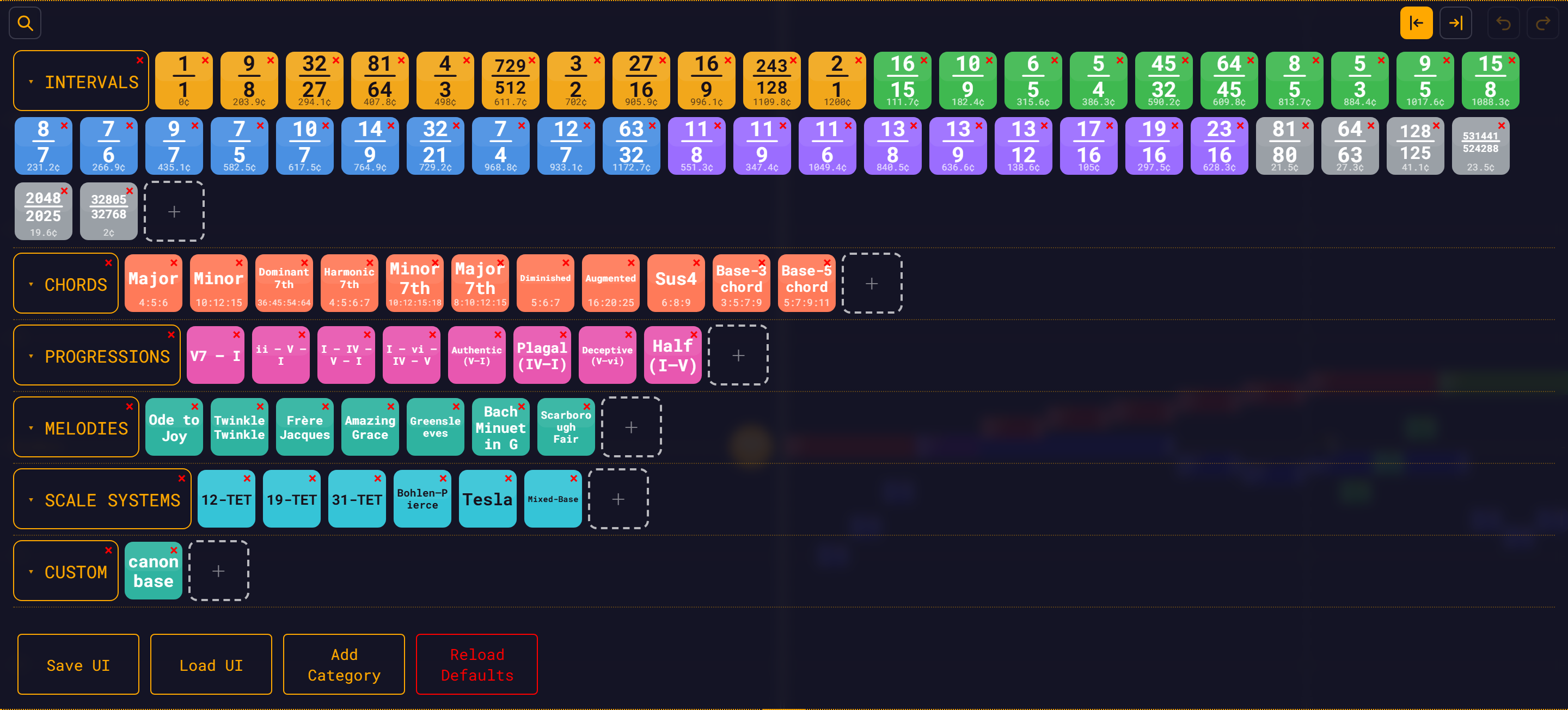
The library ships six scale modules in a section called Scale Systems. It sits in the library bar under the top bar, below Melodies — which holds seven public-domain tunes, not scales. Everything on this page lives in Scale Systems.
| Module | Notes | Base | Tempo | Step |
|---|---|---|---|---|
| 12-TET | 13 | (263/4) ≈ 65.75 Hz | 100 | × 2 ^ (1/12) |
| 19-TET | 20 | 440 Hz | 100 | × 2 ^ (1/19) |
| 31-TET | 32 | 440 Hz | 120 | × 2 ^ (1/31) |
| Bohlen–Pierce | 14 | 440 Hz | 80 | × 3 ^ (1/13) |
| Tesla | 81 | 131.5 Hz | 260 | odd-harmonic ratios (no powers) |
| Mixed-Base | 12 | 440 Hz | 90 | alternating 2-, 3- and 5-based steps |
The tiles show the module name, not the filename. TET-12.json is what's on disk; 12-TET is what you click.
Tesla is an 81-note base-3 odd-harmonic scale — the odd numbers 9, 11, 13 … 169, each over 9, stored as a chain of ratios (11/9, then 13/11, then 15/13, …). It is not an equal temperament and it does not repeat at the octave: it spans 169/9 ≈ 5077 cents ≈ 4.23 octaves, and the steps taper from 347.4¢ down to 20.6¢. Because every step is rational, no Tesla note is corrupted.
Mixed-Base is a 12-note experiment that alternates step bases — 2^(1/12), then 3^(1/13), then 2^(1/12) again, with a 5^(1/7) thrown in — and jumps straight back to base.f on note 12. It works because RMT keeps base-2, base-3 and base-5 powers as separate terms instead of collapsing them into one number.
Loading one
- Find Scale Systems in the library bar, or click the magnifier and search — the
microtonaltag surfaces 19-TET and 31-TET immediately. - Set the drop mode — Start (⇤) or End (⇥) — with the icon buttons next to Undo/Redo in the module bar's toolbar.
- Drag the tile onto a note or onto the BaseNote circle.
The drop must land on something
Dropping on empty canvas is rejected — "Drop onto a note or the BaseNote circle to import a module." Dropping on a silence is rejected too. On a successful drop, the module's base references are rewritten to the note you dropped on, so the whole scale re-roots there.
Arrows and TET
The ▲/▼ arrows on a note multiply its frequency by a ratio you configure in Settings → Arrows. On a TET note the factor folds into the rational coefficient and leaves the power term alone:
base.f * 2^(7/12) → ▲ → 2 * base.f * 2^(7/12)The note stays a 12-TET fifth; it just moves up an octave.
You cannot make an arrow a TET step
Arrow intervals must be a ratio of positive integers in [1/16, 16]. 2^(1/12) is not expressible as one. If you want to walk a note by semitones, edit the exponent in the expression.
Playing TET back
Every instrument handles arbitrary frequencies. The sampled piano and violin pitch-shift their zones by frequency / rootHz, so a 31-TET scale plays back at the pitches you wrote — they are not snapped to a keyboard. The synth voices are oscillators and take any number at all.
Set the default in Settings → Audio → Default instrument. The shipped TET modules set instrument to sine-wave on their BaseNote, which is the cleanest way to hear small pitch differences.
Choosing a system
| Use | When |
|---|---|
| Pure ratios | maximum consonance, one tonal centre, historical tunings |
| 12-TET | matching conventional instruments and recordings |
| 19-TET | you want the thirds fixed and can live with a flat fifth |
| 31-TET | you want thirds and septimal intervals, and 31 notes doesn't scare you |
| Bohlen–Pierce | you want to leave the octave behind entirely |
| Custom | anything else — any base, any number of divisions |
Next steps
- 12-TET — the reference case
- 19-TET — near-just thirds
- 31-TET — meantone and 7-limit
- Bohlen–Pierce — the tritave
- Custom TET — roll your own
- Pure Ratios — the other side of the line